projects
objekt.my / objekt-tools
A public TypeScript project for Cosmo Objekt collectors with tools for trades, lists, collection tracking, custom card generation, proofshots, and random spins.
I built objekt.my as a set of focused collector utilities rather than a single giant feature. The current public README is short, but it clearly defines the project as fan-made tools for collectors using MODHAUS Cosmo: the Gate.
What it is#
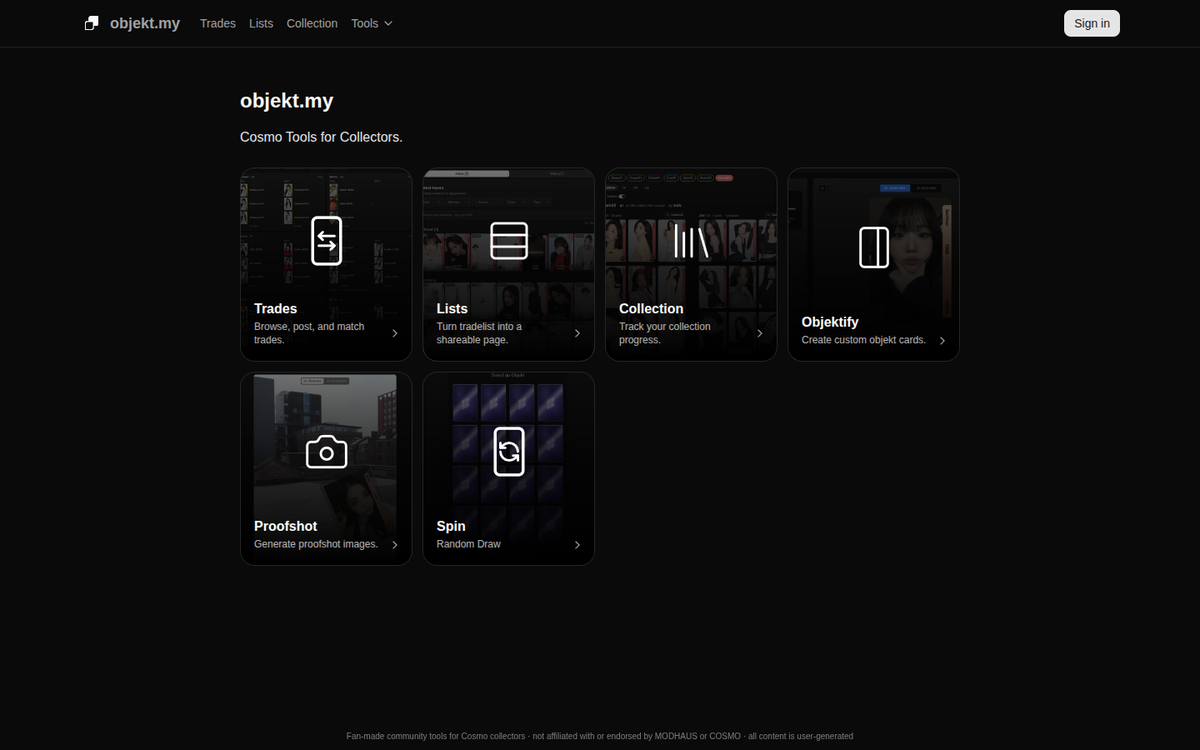
The README currently confirms six public tools: Trades, Lists, Collection, Objekt Maker, Proofshot, and Spin. That makes the project feel less like one app with one workflow and more like a toolbox built around the real habits collectors already have.
- Trades for browsing, posting, and matching Cosmo Objekt trades.
- Lists for clean have / want trade lists.
- Collection for tracking progress by member and season.
- Objekt Maker for generating custom cards.
- Proofshot for generating proofshot images.
- Spin for random draw simulations.
Why it exists#
The through-line here is convenience for a very specific community. Instead of making collectors bounce between spreadsheets, chat threads, mockup tools, and manual image edits, the project keeps those workflows in one place and makes them feel native to the hobby.
Public implementation notes#
The repository README is intentionally concise, so I only used confirmed public details here. The repo itself currently exposes a TypeScript codebase with Next.js, Drizzle, PostgreSQL, Playwright, and Vitest visible in the checked-in configuration, plus Redis for caching and Better Auth for sign-in, using Discord’s device authorization flow in place of an earlier custom login-code system. CI runs the automated test suite alongside Trivy vulnerability scanning before anything ships.
The README also credits two concrete external references: objekt-explorer for the Subsquid-based Objekt indexer used for collection progress and transfer verification, and cosmo-web for the image proxying approach around CloudFront CORS behavior.
Current limits#
The public README does not currently document setup, deployment, or deeper architectural tradeoffs, so I kept this page anchored to the confirmed feature list and the public repo structure instead of inventing details that are not published.